How to write a cover letter for a literary journal
Introduction
Online literary magazines, or lit mags for short, are websites that publish written work such as poetry, creative nonfiction, and fiction. Some also share content similar to that found in physical magazines, like comics, interviews, opinion pieces, and art. These lit mags often publish content sent to them by aspiring authors. Most of them allow anyone to send content. Almost every literary magazine requires you to include a cover letter (sometimes also called a query letter) with your submission. This post will instruct you on how to write a cover letter for your submission.
1-Find a website you like:
You can do this by searching for your favorite genre followed by the words “Lit Mag.” You can also use lit mag tracking websites, like Duotrope or Submittable. Note that these sites require you to make an account, and many, including Duotrope, require a paid subscription.
2-Review the submission guidelines:
All lit mags have different rules for submissions. Read through the submission guidelines carefully before choosing to submit. As you continue, you may need to return to the guidelines multiple times. Here is an example of a submission guidelines page, courtesy of https://www.brawllit.com/
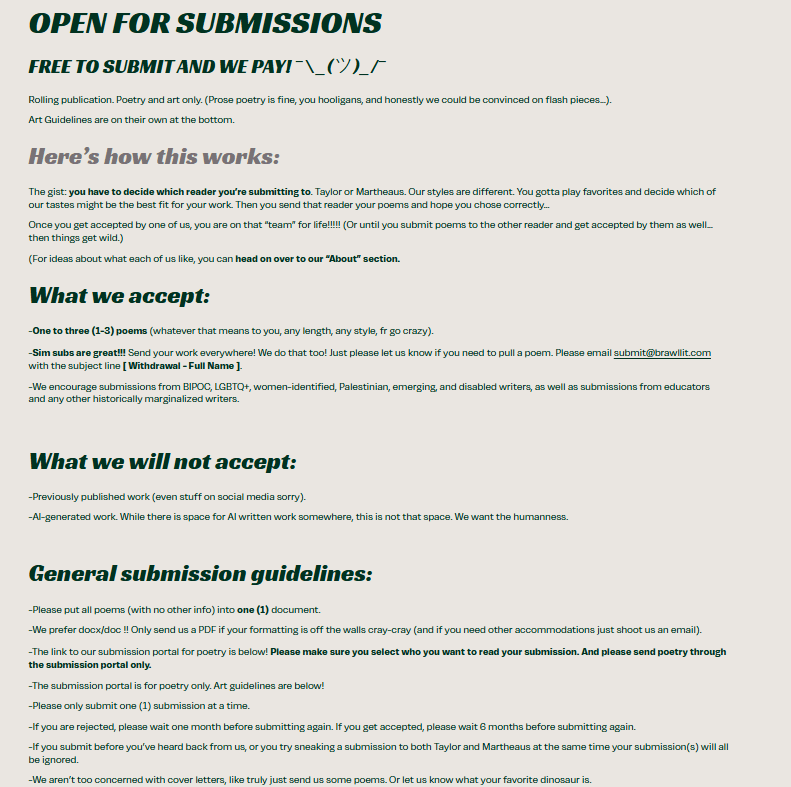
Each lit mag has a different level of formality. Make each cover letter unique to each place.
Here is an example of two very different cover letters, each tailored to their respective site:
Split Lip Magazine emphasizes formality in their guidelines. The following picture is of a letter sent to them through Submittable:

bodyfluids emphasizes informality in their guidelines. The following picture is of a letter sent to them by email:

(Optional)-Read some of the site’s content:
This step is optional but highly recommended. Reviewing other content may keep you from having your work displayed beside content you disagree with. You want to be proud to have your work published on the site. Additionally, if your work resembles the other content on the site, it is much more likely to be accepted.
3-Write your letter’s introduction:
1-Determine who to address:
Most cover letters start by addressing the editors of the site. In almost all cases, “Dear Editors of [Lit Mag],” will suffice. However, the level of formality in this aspect varies as well. An example is the guidelines from https://www.bodyfluids.org/

This example is an outlier but displays the necessity of reading submission guidelines even as you write your introduction.
2-Introduce yourself and your work
Give some basic information about yourself and the work you are submitting. If you have read content on the site, include the name of one or two that you liked.
4-Write your bio:
Each lit mag has a different word count for a bio. Aim for 50-150 words if no word count is given. Start your bio with either your name or pen name. You may wish to include your general location or if you are in school, your place of study. Give some details about yourself and include a link to your website and/or social media pages. In general, keep it simple.
5-Attach your document
If you are sending the letter by email, attach the document to the email.
WARNING:
Double check that you have attached the correct document before sending. Many authors have been embarrassed by attaching the wrong document or not attaching a document at all. Save yourself the trouble.
6-Review the letter:
Examine your letter for typos, grammar mistakes, or errors before sending it. If you use grammar tools like Grammarly or an AI assistant, use them now.
7-Send your letter:
The only thing left to do is to send it. Be patient. Most places ask for a minimum of a month before you may send an inquiry letter.
8-Rejection/Acceptance:
In the case of rejection:
Rejection is a natural part of being an author. It is very likely that your work will be rejected many times before it is accepted anywhere. Unlike job applications, when you recieve a rejection from a lit mag, you do not need to respond. Most lit mags give you a specific amount of time you must wait before submitting again. Submit elsewhere in the meantime.
In the case of acceptance:
Congratulations! You have now been published. Some sites may ask to make small edits, ask questions about formatting, or even request an interview. Work with the editors and respond as quickly as possible.
 joshuadhammond.com
Feel free to leave a reply. I’ll read them all!